
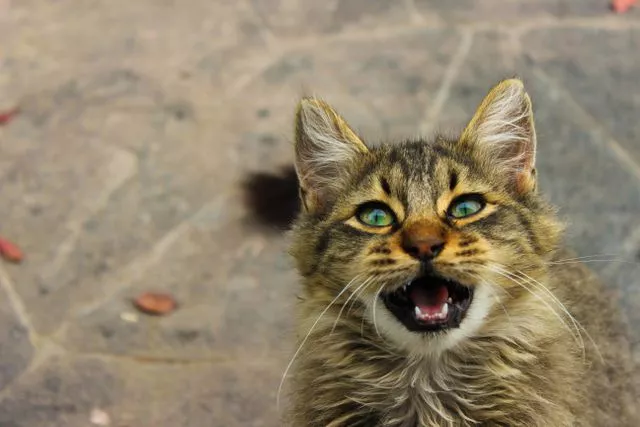
You know the sound. That insistent, almost conversational meow your cat aims directly at you the moment you walk through the door — or the second you dare hit snooze one too many times. Why do cats meow at you and not at each other? Here’s what’s wild: adult cats almost never meow at each other. That little voice? It’s for you, specifically. And when cats meow at you, they’re not just making noise — they’re communicating in a language built just for your relationship.
Why do cats meow at you? Because the meow is basically a human invention — one your cat’s ancestors spent 10,000 years perfecting.
Wild cats don’t walk around meowing at each other. They communicate through scent marking, body language, and the occasional growl or hiss. But somewhere between the first grain stores of the Fertile Crescent and your living room, something shifted. As Scientific American details, cats lingered near early human settlements, drawn by rodents — and the humans who tolerated them started getting meowed at. The cats that figured out how to work the system? They stuck around.
In fact, researchers studying cat vocalization patterns have found that domestication dramatically reshaped how cats use their voices. Unlike their wild counterparts, domestic cats developed a wider range of meow sounds specifically tuned to get a human response. The study, published in Nature Scientific Reports, shows that meows carry less individual identity information than purrs — meaning they evolved more as a general-purpose “hey, human” signal than as a cat-to-cat identifier.
So What’s Your Cat Actually Saying?
Not all meows are created equal. To understand why cats meow at you, you first need to know what they’re actually saying. A short, chirpy meow when you walk in the door is basically “oh hey, you’re back.” A drawn-out, low-pitched meow at 5 AM? That’s a negotiation. PetMD breaks down cat noises into distinct categories — from the classic meow to chirps, yowls, and the unsettling caterwaul that means either a vet visit or a territorial dispute is happening.
The ASPCA’s guide on why cats meow points out that the reasons are more varied than most owners realize: greeting, attention-seeking, asking for food, wanting to go outside (or come back in — the eternal cat dilemma), stress, loneliness, and sometimes just… talking. Some breeds, like Siamese, are notoriously chatty. Others, like Persians, treat conversation like a precious resource.
Your cat isn’t just making noise — it’s running a customized communication protocol built entirely around you. That’s the real reason why cats meow at you: they’ve learned that you respond.
Here’s where it gets really interesting. Researchers have documented that cats develop individualized vocabularies with their specific humans — a personalized secret language that gets more refined the longer you live together. A Cornell University study found that cats adjust their meows based on what works — urgent, demanding calls get food, while pleasant, appealing sounds attract adoption. Your cat’s meow to you isn’t the same as a neighbor’s cat’s meow to them. The sounds get tuned over time through what amounts to trial and error — your cat tries a sound, gets a response (food, door opened, chin scratch), and files that away. The Cornell Feline Health Center explains that cat meowing is often a learned behavior: cats discover that vocalizing gets results, so they keep doing it. The same principle is why cats ignore your commands — they’re not being defiant, they’re being strategic about what works.
Harvard researchers have even traced the evolutionary history of feline vocalizations back to the domestication of North African wildcats between 35,000 and 10,000 years ago. The theory goes that cats with meows that sounded more pleasant — or at least less alarming — to human ears were more likely to be fed and sheltered, unintentionally selecting for the vocal traits we hear today.
Here’s a fun detail you’ve probably noticed without realizing it: why cats meow at you might be different from why they meow at other people in the house. Your cat meows differently at different people — and for different reasons. My tabby has a soft, rolling trill for my partner and a sharper, more insistent bark-meow for me. It’s not random. Cats figure out which sounds work on which human, then deploy accordingly. If you’re the one who feeds them, congratulations — you probably get the food meow. If you’re the one who opens doors, you get the door meow. The cat is running a CRM system and you’re all in the database.
Cats didn’t just learn to meow at us — they learned to tailor each meow to a specific human and a specific outcome.
What’s equally fascinating is the kitten factor. Kittens meow at their mothers to signal distress, hunger, or cold. But once they’re weaned, feral kittens stop meowing altogether. The behavior only persists in cats that stay around humans. It’s like we accidentally extended kittenhood into adulthood — your ten-year-old cat is, in some ways, still talking to you like you’re mom. This retention of juvenile traits into adulthood, called neoteny, is a hallmark of domestication seen across species — and in cats, it extends directly to their vocal behavior. Meowing is just one thread in the larger tapestry of cat behavior, where every tail flick, ear twitch, and slow blink has a story to tell.
When the Meowing Means Something Wrong
Most of the time, meowing is just your cat being a cat. But there’s a line between chatty and concerning.
If your cat suddenly starts meowing excessively — especially if they’re normally quiet — pay attention. International Cat Care notes that a sudden increase in vocalization can signal pain, hyperthyroidism, cognitive decline in older cats, or even hearing loss. A cat who can’t hear themselves might meow louder because they’ve lost their own volume control.
The science behind cat meowing also reveals that cats have learned to embed a frequency within their meows that mimics a human baby’s cry — a sound we’re neurologically wired to respond to. It’s not manipulation in the malicious sense, but it is absolutely strategic. Your cat figured out, over thousands of generations, exactly which sound makes you get up and check on them.
What to Do With All This Meowing
So your cat talks to you. A lot. What now?
First, don’t punish it. Meowing is communication, not misbehavior. If your cat is meowing for food at 4 AM and you get up to feed them, congratulations — you just trained your cat to meow at 4 AM. The fix is to stop rewarding the behavior (harder than it sounds, I know) and instead set a consistent feeding schedule. And if the midnight noise goes beyond meowing, what your cat does when you’re asleep is a whole other story.
Second, if the meowing is new or different, rule out medical issues before assuming it’s behavioral. A quick vet visit can catch things like hyperthyroidism or dental pain early.
Third, lean into it. Why cats meow at humans is, at its core, a story about connection. Research shows that cats have evolved to communicate effectively with humans, using specific vocalizations — particularly the meow — that are rarely used in cat-cat interactions but are among the most common in cat-human interactions. That’s the real reason why cats meow at you — they built a language just for you. That’s not annoying — that’s one of the most unique interspecies relationships on the planet.
And if you’re looking for ways to keep that chatty cat entertained and comfortable, we’ve got a whole collection of cozy cat beds and interactive toys that might just earn you a few extra minutes of quiet in the morning. No promises, though.