
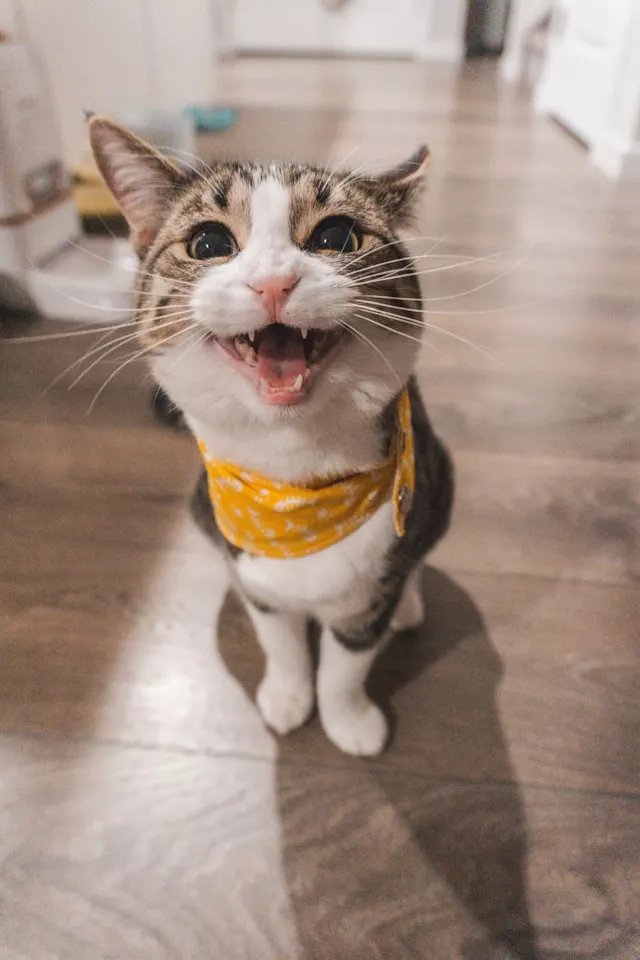
If you’ve ever traveled with your cat or watched videos of cats from different countries, you might have wondered: do cats meow differently in Tokyo than they do in Chicago? The short answer is yes—and no. The longer answer involves evolutionary biology, regional vocal patterns, and the surprising fact that adult cats almost never meow at each other.
Here’s what the research actually tells us.
Why Do Cats Meow? The Meow Is a Made-for-Humans Language
Wild cats don’t walk around meowing at each other. Cheetahs, leopards, and even feral domestic cats save their meows almost exclusively for one audience: us. Adult cats rarely use cat vocalizations to communicate with other adult cats. The meow is a behavior that cats evolved to meow specifically because they live alongside humans.
But meowing is just one piece of a much larger communication system. Cats also use body posture, tail signals, scent marking, and subtle facial expressions. Meowing is the loudest tool in the kit, but their secret language goes far beyond vocal sounds—and most of it happens in silence.
Think about it this way: kittens meow at their mothers when they’re cold, hungry, or lost. Domestic cats basically never grew out of that. Over roughly 10,000 years of domestication, they figured out that making those same sounds at humans gets results. A cat’s meow is less like a language and more like a learned tool—a sound they discovered works on us.
Quotable: Adult cats save their meows almost exclusively for humans—feral cats rarely meow at each other, making the meow a uniquely human-directed vocalization.
Do Cats Have Regional Accents?
This is where things get interesting. If cats meow differently depending on where they live, that would suggest they’re learning from us. In 2016, Swedish researchers at Lund University launched a five-year study called “Meowsic” to investigate whether cats in different regions of Sweden develop distinct vocal patterns, much like human dialects. The hypothesis was straightforward: cats living with Swedish-speaking humans might pick up melodic patterns from the language they hear every day.
Early findings suggested that cats do indeed adjust their vocal output based on their human’s speech patterns. A cat in a Swedish-speaking household produces meows with different pitch contours than a cat in an English-speaking household. The researchers found that cats’ meows rise and fall in ways that mirror the prosody—the rhythm and intonation—of the language spoken around them.
Newsweek covered the study’s implications: cats may be using vocal mimicry, not to reproduce words, but to match the emotional tone of their human’s speech. Your cat isn’t learning English or Swedish. But it is paying close attention to how you sound, and shaping its own voice accordingly. If you’ve ever wondered do cats worry about their owners when you’re away, this attentiveness to your voice is part of how they stay connected to you.
Quotable: The Lund University “Meowsic” study found that cats adjust their meow pitch and melody to match the prosody of their human’s native language—essentially developing a vocal accent.
How Humans Around the World Hear Cat Sounds
Humans don’t just speak to cats differently depending on where they live—we also hear how cats meow differently. Cat meow sounds are represented by wildly different words across languages: “meow” in English, “miaou” in French, “nyan” in Japanese, “yaong” in Korean, “miau” in Spanish, “mjau” in Swedish, and “ngiau” in Malay.
This isn’t just a trivia fact. It tells us that the same acoustic signal—the sound a cat actually makes—is filtered through different cultural and linguistic lenses. A Japanese speaker literally hears “nyan” while an English speaker hears “meow,” even though the cat is making the same sound. When you layer cultural perception on top of the cat’s own vocal flexibility, you get a communication system that’s genuinely bidirectional: cats adapt to us, and we interpret them through our own cultural framework.
Quotable: The same cat sound is heard as “meow” in English, “nyan” in Japanese, and “yaong” in Korean—proving that human cultural perception shapes how we interpret feline vocalizations as much as the sound itself.
What Science Says About Individual Cat Voices
Beyond regional differences, how individual cats meow is also distinctive. A 2025 study published in Scientific Reports found that while meows carry less individual identity information than purrs, they still contain acoustic signatures unique to each cat. In other words, your cat’s meow has a vocal fingerprint.
This is something most cat owners know instinctively. You can tell the difference between your cat’s “I’m hungry” meow and its “let me outside” meow. And you can probably recognize your cat’s voice in a room full of other cats. The science supports this: cat sounds explained across multiple studies show that domestic cats produce at least 21 distinct vocalization types, each with its own acoustic structure and purpose.
The feline vocal communication system is more nuanced than most people give it credit for. Meows, purrs, chirps, trills, hisses, and yowls all serve different functions. And within each category, individual cats develop their own repertoire based on what works with their specific humans. Of course, vocalization is just one channel—understanding cat body language is equally important, since cats say more with their posture and tail than they ever do with their voice.
Why Your Cat’s Meow Sounds the Way It Does
So what determines how cats meow? Three factors, according to the research:
- Biology. Breed, age, and vocal cord structure set the baseline. Siamese cats, for example, are famously more vocal than Persians. A kitten’s high-pitched meow naturally deepens as it matures.
- Environment. The language spoken in your home, the noise levels, and even whether you live in an apartment or a house all shape how your cat vocalizes. Cats meow for many reasons, and the environment determines which reasons come up most often.
- You. This is the biggest variable. Cats are masterful at learning which sounds get a response from their specific human. If a short, sharp meow gets you to open the food can faster than a long, drawn-out one, your cat will notice—and adjust. And while cats may seem to ignore your commands entirely, they’re actually processing your voice in their own way—it’s selective attention, not deafness.
Quotable: A cat’s meow is shaped by three factors: biology sets the instrument, environment provides the stage, and the human’s response writes the script.
What This Means for Cat Owners
Here’s the practical takeaway: when cats meow at you, they’re not just making noise—they’re talking to you in a language the two of you built together. No two cat-human pairs have the exact same vocal relationship. The meow at their humans is not a universal signal with a fixed meaning—it’s a negotiated communication system. Of course, vocal communication is just one piece of the puzzle. Whether cats even know we’re a different species is a question that shapes how we interpret every meow and purr.
This is why paying attention to changes in your cat’s vocal behavior matters. If your normally quiet cat suddenly starts meowing constantly, or your chatty cat goes silent, that’s worth investigating. Vocal changes can signal stress, pain, or cognitive decline in older cats. If you‘re concerned about these changes, explore our selection of wellness products for senior cats to support your feline friend.
The Bottom Line
So do cats meow in different accents? The research suggests yes. No, cats don’t all meow in the same language. Every cat develops its own dialect, shaped by its biology, its environment, and—most importantly—its relationship with you. The next time your cat meows at you, you’re not just hearing a generic animal sound. You’re hearing a vocal signature that exists nowhere else in the world, built over thousands of years of evolution and fine-tuned over the lifetime of your friendship.
For the full picture on every aspect of feline behavior—from body language to bonding to problem-solving—check out our complete guide to cat behavior. It connects 21 articles across five major categories, so whatever your cat is doing that you don’t understand, there’s an answer waiting.