
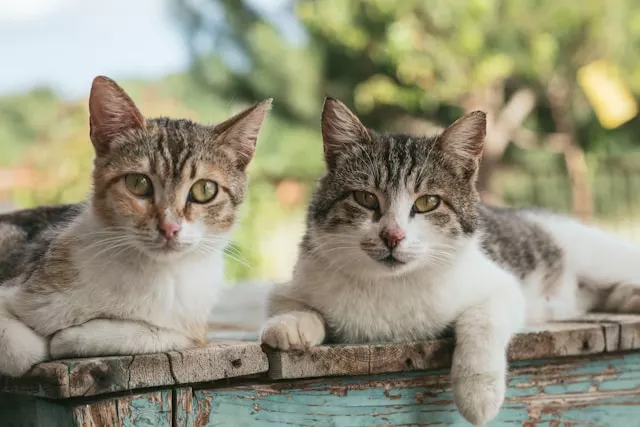
A few years back, a neighbor’s cat gave birth to a litter of four in my laundry room. I ended up fostering the whole crew for about three months before rehoming the kittens. That’s when I first realized: cats teach other cats in ways that are genuinely surprising.
It wasn’t just “mom feeds babies.” The queen—Minka—was running a full-on survival academy. She showed them how to stalk, how to pounce without breaking a toe, how to judge distance before launching off the sofa armrest. And she graded their work. Kittens who lunged too early got a paw swat. Kittens who nailed it got grooming. This experience offered undeniable proof that cats teach each other in structured, deliberate ways—far beyond simple instinct.
Key Takeaways on Feline Social Learning
- Cats teach each other through active demonstration, not just instinct.
- Observational learning in cats begins in the mother-kitten classroom.
- Adult cats rely on feline social learning to establish feeding and territory rules.
- Allogrooming is a tactile form of multi-cat household behavior transmission.
- Understanding how cats learn from each other helps owners prevent mischief.
Not Solitary: Social Groups and Observational Learning
Most people assume cats are solitary. That’s only half true. While wildcats hunt alone, domestic cats form complex social groups—colonies of related females who share kitten-rearing duties. And in those groups, observational learning in cats is constant.
The Mother‑Kitten Classroom: More Than Nursing
The mother-kitten classroom is where it all starts. A queen doesn’t just feed her litter—she actively demonstrates. Research on feline social learning shows that kittens who watch their mothers hunt begin developing usable stalking techniques weeks earlier than orphaned kittens raised alone. A study published in Frontiers in Veterinary Science found that social play between cats isn’t just exercise—it’s a mechanism for learning “social skills and social role” in a rapidly changing environment.
The Litter Box Lesson: No Human Training Needed
And honestly? The litter box was the wildest lesson. I watched Minka walk each kitten to the box, paw at the litter, wait for the kitten to try, then groom whoever got it right. Every single kitten was box-trained by week five without me lifting a finger. That’s what cats teach other cats that no YouTube tutorial can replicate.
Hunting Practice: Half‑Dead Prey and Toys
Hunting is another big one. A mother cat in the wild will bring half-dead prey back to the nest—not because she’s lazy, but because she wants the kittens to practice the kill. Domestic queens do the same with toys. I’ve seen Minka bat a toy mouse toward a kitten, then sit back and watch the kid fumble with it, tail twitching like a coach on the sidelines. It’s deliberate teaching, not random play. The Humane Society of Missouri notes that “kittens need the opportunity to play in order to learn vital adult skills both for communication and for hunting.” Whether with live prey or toys, this ritual confirms that cats teach each other the mechanics of the kill through repeated, supervised practice.
Adult Cats Teach Each Other Too
Beyond the mother-kitten dynamic, adult cats teach each other daily routines. In fact, observational learning in cats persists throughout their entire lives. Adult cats teach adult cats too—and this part gets overlooked a lot. When I introduced a new rescue cat named Edgar into the house, he had zero food manners. He would scarf his bowl in 30 seconds, then try to bully the other cats off theirs. Within three days, my resident senior cat Leo had taught him—mostly through hissing and strategic paw blocks—to wait his turn. Did Leo intend to teach? Hard to say. But Edgar learned.
There’s formal research backing this up. A 2022 ethological analysis in Scientific Reports examined close-contact interactions between cohabiting cats and found clear evidence of social learning and behavioral transmission, especially around feeding routines and territory boundaries. This study provides empirical evidence that cats teach each other not just through instinct, but through active behavioral adjustment. Translated: your cats are watching each other and adjusting behavior all the time. And when you’re wondering how much of those shared experiences actually stick — what cats remember goes way beyond simple routine, from recalling specific events to recognizing names.
Allogrooming: Affection and Tutorial Combined
Grooming is my favorite example. It’s a prime illustration of how cats teach each other social nuances through tactile interaction. Allogrooming—cats licking other cats—is partly affection and partly a tutorial. Kittens learn exactly which spots to groom and for how long by being on the receiving end first. Adult cats who grew up without other cats often over-groom or under-groom because they never got that demonstration. A separate study published in the American Journal of Veterinary Research further confirms that allogrooming is a key affiliative behavior significantly linked to how familiar and closely related cats are to one another. Thus, allogrooming stands as one of the primary mediums through which cats teach each other emotional and physical boundaries.
The Litter Box Full Circle
The litter box thing comes full circle here too. If you bring a new kitten into a home with a well-trained resident cat, the kitten often just follows the older cat to the box and figures it out through observation. No human training required. International Cat Care advises that in multi-cat households, cats frequently learn household routines—including acceptable scratching surfaces and feeding schedules—by modeling the resident alpha cat’s behavior.
Less Adorable Lessons: Opening Cabinets, Stealing Treats
Some behaviors are less adorable. I’ve had cats teach each other how to open cabinet doors. One brilliant cat figures out the latch, and within a week, three cats are raiding the treat drawer at 3 a.m. Cats really do copy each other in both useful and destructive ways, and that’s backed by plenty of owner-anecdotal evidence documented on sites like ASPCA, which notes that kittens learn essential survival skills by observing and imitating their mothers.
What This Means for Multi‑Cat Homes
So what does this mean if you’re running a multi-cat home? For starters, the first cat actually trains the second one for you—at least around food routines, litter habits, and acceptable play boundaries. Recognizing that cats teach each other both good and bad habits is the first step to managing a harmonious home. A certified feline behavior specialist points out that problem behaviors in multi-cat households often stem from one cat “teaching” another a maladaptive habit, especially around resource guarding and door darting.
Discipline Gets Passed Down Too
Discipline gets passed down too. A mother cat will remove a misbehaving kitten from the group—physically carry it away—to signal “that’s not okay.” This isn’t just punishment; it’s social boundary instruction. As one detailed guide on queen behavior explains, “mother cats discipline their kittens as a part of normal feline behavior and socialization,” helping kittens understand “what behaviors are off-limits”. Through such discipline, cats teach each other the boundaries of acceptable social behavior – a lesson that persists into adulthood.
Adding a Second Cat? Let the Resident Be the Teacher
For anyone thinking about adding a second cat: the resident cat’s personality matters enormously. A calm, well-socialized older cat can be a better teacher than any amount of human training. WebMD recommends structured introductions and notes that “creating a harmonious environment in a multi-cat household requires careful planning” and an understanding of how cats communicate and learn from one another.
Just Watch Your Cats
You don’t need a degree in animal behavior to see this in action. Just watch your cats—because every swat, groom, and meow reveals how cats teach each other the unwritten rules of your home. Pay attention to who grooms whom, who eats when, which cat the kitten follows around the house. The teaching is happening whether you notice it or not.
Gear That Survives Multi‑Cat Teaching
And if you’re looking for gear that actually supports multi-cat harmony—scratching posts that hold up to tag-team shredding sessions, litter mats that survive the kitten-learning phase—check out what we’ve collected at Purrfellow’s shop. Nothing fancy, just stuff that won’t fall apart the second a cat decides to demonstrate proper scratching technique to a trainee.