
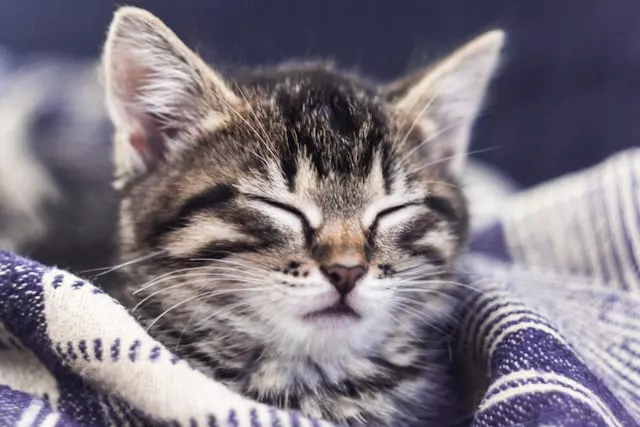
Do cats really understand why we leave? Cats don’t understand the concept of a job or school the way humans do. They have no framework for “employment” or “education.” What they do have is pattern recognition that borders on obsessive. Your cat knows the sequence: keys jingle → bag gets picked up → you walk out the door → you’re gone for a while. That’s the part they’ve nailed. But the why behind it? That’s where things get fuzzy.
A 2019 study from Oregon State University flipped a lot of assumptions about feline emotional detachment on their head. Researchers ran cats through the same “secure base test” used on human infants and dogs — and found that roughly 65% of cats formed secure attachments to their owners. The cats genuinely relied on their humans as a source of safety. When their person left the room, the securely attached cats showed visible distress. When the person returned, they calmed down.
So when we ask do cats understand why we leave, the research suggests they’re less focused on the reason and more focused on whether you’re coming back.
Cats are masters of routine
They don’t read clocks, but they absolutely read environmental cues. The angle of sunlight through the window. The neighbor’s car starting. The gradual shift in household noise. The RSPCA notes that cats understand their world primarily through consistency and repetition — not hours and minutes, but the familiar sequence of events that make up their day. There’s a reason your cat is at the door waiting for you at 5:52 PM every single day.
Do cats experience separation anxiety?
The question do cats understand why we leave gets more complicated when you look at separation anxiety. A Psychology Today piece reported that more than 1 in 10 cats display behaviors linked to separation-related distress — excessive vocalization, destructive scratching, urinating outside the litter box. That’s not a cat who’s indifferent to your absence. That’s a cat who’s stressed by it.
One of the clearest signs that your cat is struggling: they start acting differently in the 10-15 minutes before you typically leave. Hiding. Following you more intensely than usual. Some cats even block the door. VCA Animal Hospitals notes that many cats exhibit signs of anxiety when they are left alone — and true separation anxiety mimics what we see in dogs, just subtler and easier to dismiss as “cats being cats.”
The good news? Cats have an internal clock that’s surprisingly precise. PetMD confirms that cats can develop separation anxiety syndrome, and they distinguish between short absences and long ones. If you’re gone for 30 minutes versus 8 hours, your cat knows the difference. They don’t grasp the abstract concept of “work,” but they absolutely understand the rhythm of your comings and goings.
So what’s actually happening in that little furry head?
Here’s my best guess, based on the science: your cat doesn’t think “my human is off to earn money for kibble.” They think something closer to:
“The tall creature who feeds me and smells like safety is doing the thing where they disappear for the daylight part of the cycle. They always come back when the light gets low. I’ll wait.”
The attachment piece is real, though. The ASPCA notes that separation anxiety is triggered when cats become upset because of separation from their guardians — the people they’re attached to. Cats with secure bonds show increased activity in the first 30 minutes after their owner leaves: pacing, vocalizing, sometimes refusing food. They settle eventually, but the initial separation matters. And when owners return, greeting behavior — rubbing, tail-up approaches, purring — is significantly more pronounced after longer absences.
How to help your cat while you’re at work
If you’re worried about your cat while you’re at work, some things actually help:
- Leave a worn t-shirt on the bed – your scent is genuinely calming. (ASPCA)
- Set up a window perch with a view of birds or street activity.
- Puzzle feeders give them something to work on during the day.
- Reach out to your veterinary team if you’re worried – some cats benefit from anti-anxiety interventions. (VCA)
Fun fact: cats seem to know you’re coming home before you pull in
Battersea Dogs & Cats Home suggests that cats are incredibly attuned to routine and subtle environmental shifts — the sound of a specific car engine, the vibration of the garage door, the neighbor’s dog barking at a predictable time. It’s less about psychic abilities and more about cats being absolutely obsessive students of their own environment.
The bottom line
The Humane Society of the United States emphasizes that the key to helping your cat feel secure is a predictable routine and plenty of positive interaction when you are home.
Do cats understand why we leave — in the sense of comprehending the concept of a job, a paycheck, or a 9-to-5 obligation?
No, they don’t. And honestly, that’s kind of liberating.
Your cat doesn’t care about your career title or your GPA. They care about the pattern: you leave, you come back, you feed them, you’re their person. The consistency matters more than the explanation. As International Cat Care puts it, understanding a cat’s natural behavior is the foundation for a happy relationship.
And if you’re looking for stuff that makes the “you’re gone” hours a little easier on your cat — scratching posts that hold up to all-day use, puzzle toys that actually engage a feline brain, window perches with solid suction cups — there’s a small collection of things we’ve tested and like over at Purrfellow’s shop. Nothing fancy, just gear that holds up.