
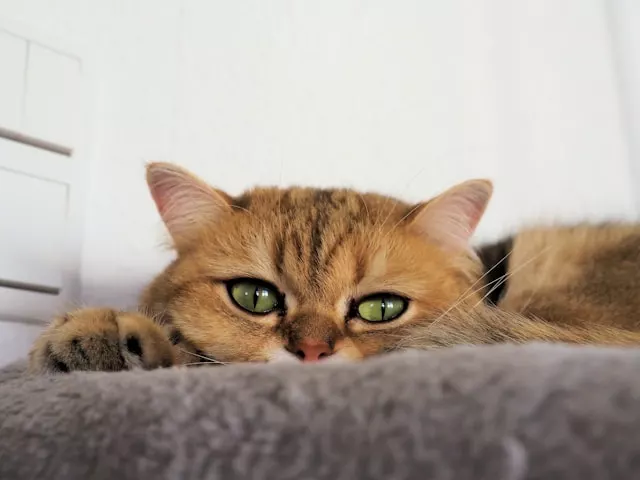
You grab your keys, slip on your shoes, and head for the door. Your cat is sitting on the arm of the sofa, watching you with those half-closed eyes. Maybe she flicks her tail. Maybe she blinks slowly. And then the door clicks shut. I can’t help but wonder — what do cats think when we’re gone?
What happens next? Does she just… wait? Does she wonder where you went? Does she think you’re never coming back?
I’ve found myself wondering this more times than I’d care to admit. So I dug into the research and talked to what the experts have to say. Turns out — the answer is more interesting than you’d expect.
Cats Don’t Think Like We Do
Before we get into what’s going on in that furry little head, we need to understand one thing: cats experience the world differently than humans. Their sense of time, their memory, and their social expectations are all shaped by thousands of years of evolution — first as solitary hunters, then as semi-domesticated house guests.
A cat’s brain simply isn’t wired to wonder, “Is my human at the office right now?” That kind of abstract thinking just isn’t how their minds work. According to cat behavior specialists, cats live much more in the moment than we do. When you’re gone, you don’t exist to them in the same way.
But that doesn’t mean they don’t notice you’re missing.
Object Permanence: Out of Sight, Out of Mind?
One of the most important concepts here is object permanence — the understanding that something still exists even when you can’t see it. Human babies develop this around 8–12 months. Cats? They’ve got it too, just maybe not as strongly as we do.
A 2019 study from Oregon State University found that cats form secure and insecure attachments to their owners, similar to what you’d see in dogs and even human children. Cats really do bond with us. But the way they process our absence might be different. You can explore more about common cat behavior issues at ASPCA.
So when you walk out that door, your cat knows you still exist somewhere. She just doesn’t know where — or when you’re coming back. And honestly? That uncertainty might be harder on her than if you’d just vanished completely from her awareness.
Routines Matter More Than Reasoning
Here’s where it gets practical. Your cat might not be sitting there thinking “I miss my human,” but she definitely knows your routine.
Does she get restless around 5 PM? Does she start waiting by the door when she hears certain sounds? That’s her internal clock ticking. Cats are masters of pattern recognition. They learn the sounds of your car, the time you usually feed them, the footsteps on the stairs that mean you’re home.
But according to behavior experts, cats can feel genuine stress when routines are disrupted or when they’re left alone for longer than they’re used to. It’s not the same as “worrying about where you are” — it’s more like a sense that something is off in their environment. For more insights on cat behavior and welfare, check out RSPCA’s behavior guide and International Cat Care.
What Cat Behavior Tells Us
So if cats can’t tell us what they’re thinking, we have to watch what they do. And the signs are often subtle.
Some cats sleep the entire time you’re gone. To them, your departure is a signal — “OK, time to nap until the food person comes back.” Others pace, meow, or sit by the door. A few might even get destructive, scratching furniture or knocking things over.
These behaviors exist on a spectrum. A cat that’s relaxed when you leave and greets you casually when you return is probably doing just fine. But a cat that anxiously follows you from room to room, meows excessively when you’re about to leave, or shows signs of stress like over-grooming or litter box avoidance might be struggling with being alone. You can learn more about creating a harmonious home for your cat at Cornell Feline Health Center.
The Routine-Change Experiment
I’ve noticed this with neighborhood cats I’ve watched for friends. One cat, a gray tabby named Binx, is perfectly fine when his owner leaves for a standard 8-hour workday. Slept the whole time. But when his owner went on a week-long vacation and I came by twice a day? Binx stopped eating for the first two days. Not because he was hungry — because the routine was wrong.
The length of absence matters less than the consistency of the routine. Cats can adapt to you being gone for 10 hours a day if it happens the same way, at the same times, every day. It’s the unpredictable changes that throw them off.
Do They Think We’re Hunting?
There’s a popular theory floating around online that cats think we go out to hunt when we leave. It makes for a cute story — your cat imagining you stalking prey in the urban wilderness. But there’s no research to support this idea, and it doesn’t really fit with what we know about how cats see us. For a deeper look at what science says about feline loneliness, visit Texas A&M.
If anything, your cat probably thinks of you as a large, clumsy, but very useful cat who provides food and warmth. When you leave, they’re not picturing you bringing home a mouse. They’re more likely cataloging the change in their environment and adjusting their behavior accordingly.
What Science Says About Cat Attachment
The Oregon State University study on cat attachment, published in Current Biology in 2019, was a big deal when it came out. It showed that cats, like dogs and human infants, can have secure or insecure attachments to their caregivers. In secure attachment, a cat explores confidently when their owner is present and shows mild distress when they leave — but is easily comforted on their return. Read the full study here, and explore related academic research on PubMed.
Insecure attachment shows up as either excessive clinginess or avoidance. And here’s the interesting part: the type of attachment seems to be influenced by how the owner interacts with the cat, not by the cat’s personality. In other words, you shape how your cat feels about you leaving.
Making Goodbyes Easier
So what do cats think we’re doing when we’re gone? The honest answer is: they’re probably not thinking about it in any way we’d recognize. But they are experiencing something. They notice our absence. They track time through routine. And they feel the gap we leave in their daily patterns.
If you want to make that gap easier for your cat:
- Keep a consistent schedule. Feed them at the same times, leave and return at predictable hours.
- Don’t make a big deal of leaving. Long, emotional goodbyes can actually increase anxiety. A calm exit is better.
- Leave enrichment behind. Puzzle toys, window perches, and interactive feeders can keep their mind occupied.
- Consider a companion. Some cats genuinely do better with a feline friend around.
- Watch for signs of real distress. If your cat is showing signs of separation anxiety, talk to your vet.
For more detailed guidance on setting up your home to keep your cat happy and stimulated while you’re away, check out the resources from the RSPCA and learn how to build a cat-friendly environment that gives them plenty to do even when no one’s home. You can also read more about stress in cats from International Cat Care, which explains how environmental changes can affect your cat’s wellbeing.
The Bottom Line
Your cat probably isn’t composing a tragic soliloquy about your absence. But she’s not emotionless either. She lives in a world of routines, sensory patterns, and immediate experiences. When you leave, she notices. She adjusts. And when you come back, she greets you in her own understated way — maybe a head bump, maybe a slow blink, maybe just the satisfaction of a routine restored.
That’s not ancient hunting instincts or deep philosophical pondering. It’s just love, in the quiet form cats have always offered it.
If this helped you better understand your cat’s world, you might also want to check out our detailed analysis of cat behavior and enrichment products designed to make your cat’s alone time more comfortable.